Turncrafter Commander 12 Variable Speed Midi Lathe Reviews
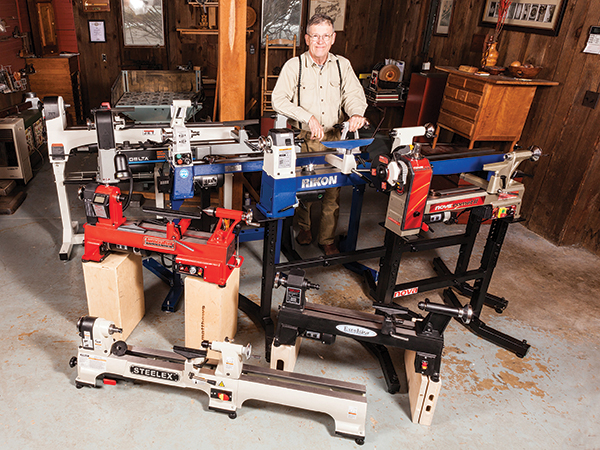
Nosotros tested and reviewed viii of the top mini and midi lathes. Each includes a multifariousness of features that will satisfy woodturners of dissimilar skill levels. Discover out which of these is the all-time benchtop lathe for your shop.
During the last decade of the 20th century, a number of manufacturers brought out versions of their standard 1″ 10 8 TPI lathes with a short bed. Aimed at the rising tide of pen turners (the first pen kits came out in 1987), they were dubbed "mini lathes." To machinery producers' delight, these small lathes also found neat popularity with model makers, teenagers and those just wanting to try turning without spending a fortune. The first mini lathes sported viii″ to 10″ swings and 12″ to fifteen″ between centers.
During the first ten years of this century, many manufacturers beefed up the bed of their mini lathes and raised the spindle top to yield a 12″ swing. Delta was probably the first to dub these upsized machines "midis," but the terminology of mini as 10″ or smaller and midi as 12″ and bigger is at present part of the popular lexicon.
Lathe makers have all added bed extensions that take the midi back in the direction of the standard workshop lathes of my youth (which had an 8″ to x″ swing and 29″ to 36″ between centers and were intended to be placed on a workbench or shop-built stand). Typically, adding i extension extends the nose-to-nose distance between the spindles to between 37″ and 45″. This makes midi lathes a skillful pick for furniture builders who desire turning in their repertoire. Additionally, most midis and minis now have variable speed, ordinarily with a DC motor and controller. Today's midi lathe makers also offer proficient quality stands with more adequate height adjustment — a skilful matter, as putting a modern midi on a workbench may make the spindle too high, especially for a young person. (Ideally, the center of the spindle of a lathe should exist at elbow acme. Past workbenches, designed for hand tool woodworking and shorter statures, were typically 33″. Today's benches, designed more for router apply and taller people, take grown to equally high every bit 36″.)
Lathe Capacity Factors
For this article, I had a hazard to test out eight of today'due south midi and mini lathes. I took each 1 for a drive with identically sized spindles from the aforementioned plank of forest. This enabled me to experience how each automobile feels and behaves, which I believe is more than important than raw specifications.
That said, in that location are some important factors in the chapters of a lathe: the heart height, the height of the banjo and the altitude between centers. Manufacturers will list swing as twice the center acme: what the machine will swing over the bed. The true swing of a lathe, however, is center height over the banjo, considering this base for the tool-rest has to be nether all spindles and almost faceplate work. Two lathes with the aforementioned swing could have different banjo heights.
Likewise, between-center altitude is oft listed equally the spindle nose to tailstock nose altitude. The necessary drive and live centers to hold a spindle would lessen this amount. For this tool review, I have provided the distance with the dorsum of the tailstock even with the terminate of the bed and the same fix of low profile centers for all the lathes. (You can usually gain a bit more altitude by hanging the tailstock an inch or so off the bed.)
A Word About Speed
Variable speed has become a standard feature in all but budget priced machines, which retain belt and pulley speed adjustment. If you are on a upkeep, there is nothing wrong with changing pulley groves to change speeds; it was washed that way for centuries.
All manufacturers have gone from V-chugalug/pulley power transmission to poly-V. Poly-5 belts are far superior for steady speed and power delivery, eliminating the surging and slippage common to the V-belt. All variable speed machines in this review retain step poly-5 pulleys as part of the command package.
Liken the steps to the gearshift in a car and the speed controller to the accelerator. Putting the lathe belt on the smallest diameter motor caster is equivalent to first gear in your auto. This gives you more torque at the spindle and more control over that speed range, ameliorating the danger of going besides fast in faceplate piece of work. All simply i of the lathes had DC motors with DC controllers. Turning a knob clockwise increases speed; counterclockwise slows things down.
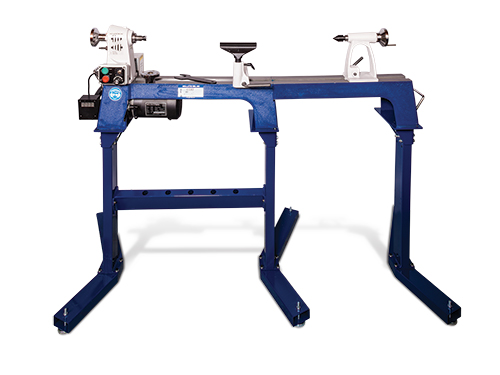
COLT SML-350
Motor Size: 1hp (true)
Speed: fourscore-100 / 170-i,700 / 560-3,700 rpm
Digital RPM Display: Yep
Swing Bed/Banjo: 14″ / ten-iii⁄8″
Heart to Center Distance: 16-1/2″ / 38-3⁄16″ with Extension
Street Price: Lathe $1,000 / Ext $250 / Stand $280 / Total $1,530
Spider web / Phone: world wide web.colt-tools.com / 49 (0) 2266 1266
The COLT lathe had the biggest swing of all the lathes in the test, with xiv″ over the bed and 105⁄8″ over the banjo. It was also the only lathe with a frequency drive, used in tandem with an consecration motor. Frequency drives accept normal, single-stage Air-conditioning current at sixty cycles/hertz (fifty Hz in Europe) and deliver iii-phase current at any bicycle rate betwixt 2 and 70 Hz. Since cycle rate controls the speed of a 3-phase consecration motor, this allows a 1,725 rpm motor to run anywhere between 57 and two,800 rpm with practically no drop in torque at slow speeds. Frequency drives are seldom seen on lathes under 1-1⁄2hp, so COLT has a first here. The DC motors with a DC controller used in the other lathes accept a meaning fall-off of the torque curve at lower speeds.
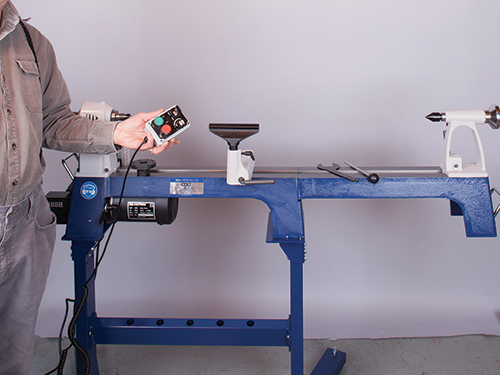
This was likewise the just user manual that cautioned on the noise level of the lathe — 79 decibels. All lathes are this noisy; the danger comes not from the lathe itself, but from the work striking a spindle roughing-out gouge or a bowl gouge during the interrupted cuts involved.
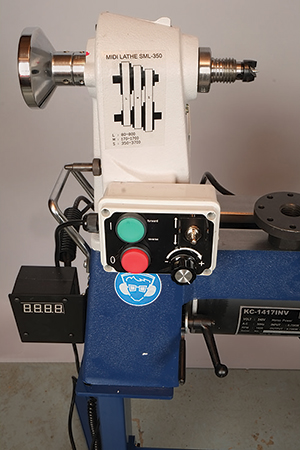
The Colt'due south digital speed control actually reads the speed of the headstock pulley with an LED sensor. It also has a quality live eye, a high level of fit and terminate, and is ane of only 2 lathes in the exam with a ane″ tool-remainder stem diameter. Information technology'southward a dream to turn on, with enough of power and no vibration.
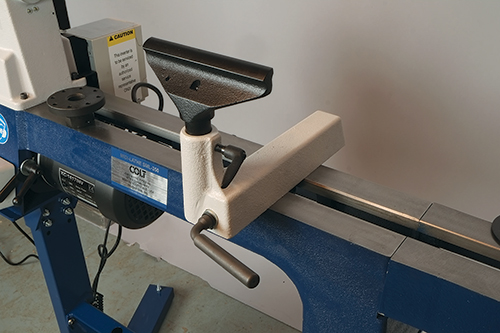
The COLT stand had a leg that attached to the finish of the extension only was non tied to the rest of the stand up with a cantankerous-member, which makes removing the extension and leg piece of cake for those wanting to save floor space except when turning long spindles. A lifting handle can exist moved to the extension. If you are non going to buy the stand, this makes lifting the lathe on and off the bench much easier.
The stand up could, nonetheless, use some slight improvements, such as putting plastic plugs in the ends of the support tressels.
As is, and if price is no object to you, this lathe ties for my overall first pick.
Rockler Excelsior
Motor Size: 1/ii hp
Speed: 760 / 1,100 / i,600 / 2,200 / 3,200rpm
Digital RPM Display: No
Swing Bed/Banjo: 10″ / seven-1⁄4″
Middle to Center Distance: 17-ane⁄4″ / 37-three⁄4″
Street Toll: Lathe $300 / Ext $75 / (no stand up) / Total $375
Web / Telephone: world wide web.rockler.com / 800-279-4441
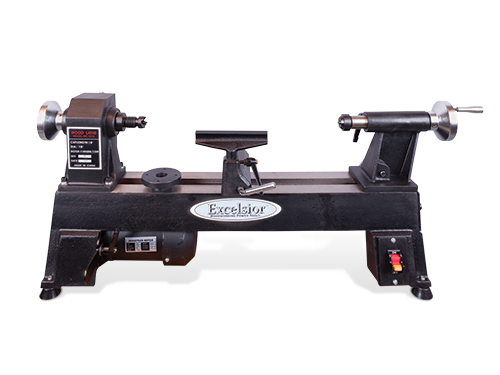
The Excelsior is a 10″ mini lathe true to the original concept of a mini lathe — a elementary, portable lathe that works well and does non accept up much space. It has all the basics: good fit and cease, decent controls and an induction motor with v-stride caster speed control, for a very affordable price signal. The banjo, tool-rest and tailstock levers worked hands.
Its small-scale size and modest weight give information technology dandy portability and the ability to store easily when not in use. I know an avid woodturner who keeps an Excelsior in his motor home to turn at campgrounds. Similar the Penn State Turncrafter Commander and the Steelex, it does not have reverse — which, again, in my opinion, is non very important.
With five speeds, anything within its capacity can exist safely and efficiently turned. One advantage of footstep pulley speed control is that there is dandy depression speed torque, which is not the case with DC motor/controller equipped lathes. If your turning will be confined to miniatures or pens, you will be doing about of your piece of work in the i,600, 2,200 and 3,200 rpm belt steps.
Adding the $75 bed extension would turn the Excelsior lathe into an adequate lathe for all but the largest furniture spindles. The Excelsior is a great lathe for a young aspiring turner or anyone wanting to turn miniatures or pens.
DELTA 46-460
Motor Size: 1hp
Speed: 250-750 / 600-one,800 / ane,350-4,000 rpm
Digital RPM Display: No
Swing Bed/Banjo: 12″ / ix-1⁄2″
Eye to Center Distance: 16-i⁄two″ / 42″ with Extension
Street Toll: Lathe $580 / Ext $130 / Stand $160 / Total $870
Web / Phone: www.deltamachinery.com / 800-223-7278
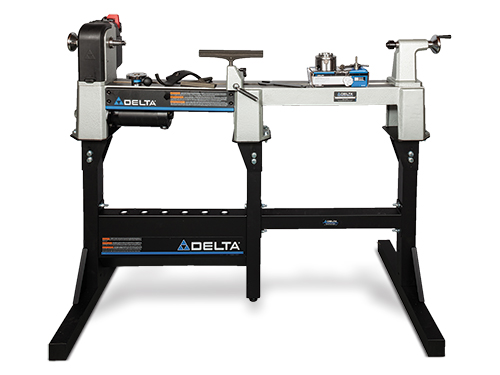
I actually appreciated the make clean, industrial design of the DELTA 46-460. It'southward an overall blueprint concept, from the instruction manual to the color choices and logo, with great graphics. The manual, with lots of photos and good information, was the best of the bunch.
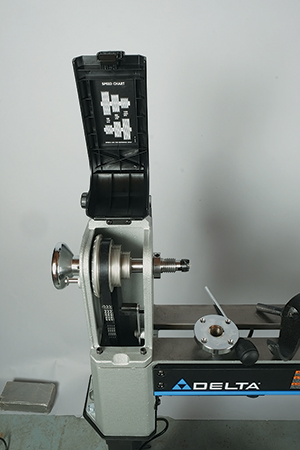
To bring rubber to reverse management, most of the lathes have setscrews in the faceplate, which tighten into a groove simply ahead of the spindle shoulder to lock the faceplate on the spindle during reverse operations. The JET, along with the Colt and the DELTA, also had Nylok® grub screws, which are akin to using a lock washer with a nut and volition not turn without some force being applied to the hex key.
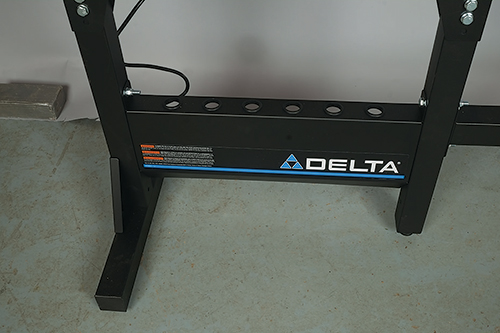
This lathe also has a get-go-rate fit and finish. The stand was well idea-out, with a built-in tool rack that tin agree up to 6 tools. Area for comeback? I wish information technology had digital readout.
It's very pleasant to employ, with skilful power and plenty center-to-center distance (with the extension) for any piece of furniture spindle.
JET JWL 1221VS
Motor Size: 1hp
Speed: 60-900 / 110-1,800 / 220-three,600 rpm
Digital RPM Display: Yes
Swing Bed/Banjo: thirteen″ / 9-one⁄4″
Heart to Center Distance: 18-ane⁄8″ / 38-1⁄eight″ with Extension
Street Price: Lathe $800 / Ext $199 / Stand up $518 / Full $1,517
Web / Telephone: world wide web.jettools.com / 800-274-6848
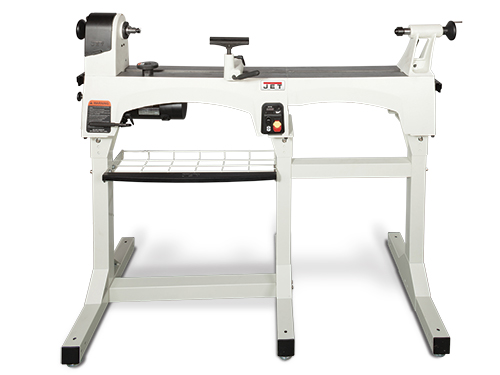
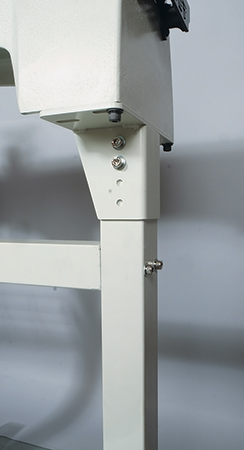
This Jet 1221VS lathe has a super-heavy construction and a high level of fit and cease. Its very solid stand is absolutely offset-rate. I was very impressed with the stand, which has been redesigned. We received one of the first for this article. All of the bolt holes aligned perfectly with peak quality fasteners threading into tapped holes. All of the fasteners on the stand itself are chrome-plated socket caput cap screws, while the lathe is affixed to the stand with contrasting blackness oxide cap screws.
While I even so encourage turners to build a wood correspond their lathes, OEM stands in general, and particularly the JET's, have gotten so good every bit to warrant serious consideration. Stands, shop-congenital or purchased, make the lathe more accessible while preserving precious demote space. The JET 1221VS lathe has very make clean pattern, which has been a large thrust of the company. All parts move smoothly and locking handles are stylized and pleasant to use. Many niceties are included, such as metallic racks that spiral to each end of the bed for Morse taper accessories and the knockout bar. A wire rack holds chucks and faceplates simply allows chips to filter through.
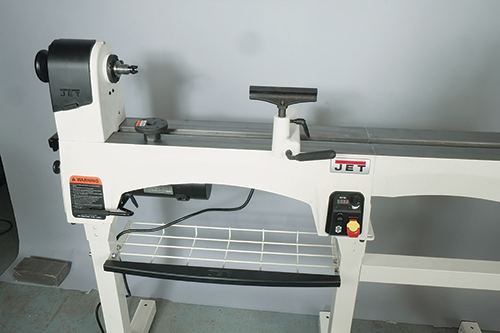
The JET JWL 1221VS, sectional of price consideration, ties for my first pick. If it had a frequency drive and induction motor, at to the lowest degree as an option, information technology would be my absolute first selection. There is a reason why so many of my students, as well as turning clubs, rely on this machine. They dorsum up the automobile with a five-year warranty and long-term replacement part supply.
NOVA Comet II
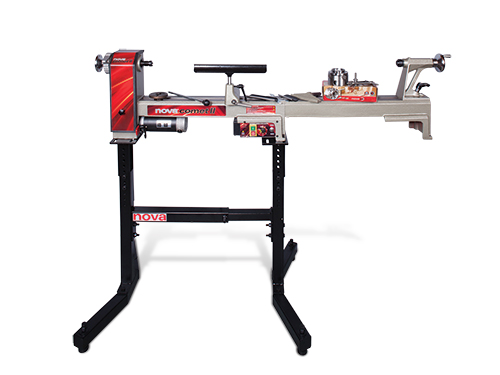
Motor Size: 1hp
Speed: lxxx-800 / 170-1,700 / 360-3,700 rpm
Digital RPM Display: No
Swing Bed/Banjo: 12″ / 9-3⁄8″
Center to Center Distance: 16-1⁄2″ / 42″ with Extension
Street Toll: Lathe $580 / Ext $130 / Stand $160 / Total $870
Web / Telephone: world wide web.novatoolsusa.com / 866-748-3025
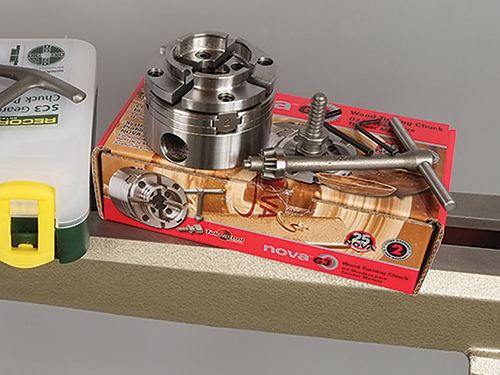
NOVA is the make name of Teknatool International Ltd., a New Zealand company that has its own plant in mainland Communist china. NOVA was the first visitor to bring a reliable and innovative four-jaw chuck to woodturning, and they at present brand a wide range of chucks and jaws. They supplied a G3 chuck with the lathe for review. DELTA also offers the G3 as an accompaniment for their lathe.
The NOVA Comet Ii bed sections are modular, meaning that more than one can be added to get farthermost between-eye spindle distances. I do feel the stand is incomplete, as there is no leg bachelor for the unmarried extension nosotros requested for this review. That is the reason I did not adhere it for the photography. This is a deficiency I would strongly urge Teknatool to correct. The lathe also has no digital readout and no set screws in the faceplate to prevent unscrewing when the lathe is in reverse. Overall, the Comet II is a smooth motorcar with adequate ability, pleasant controls and clean industrial design.
The NOVA Comet 2 outboard grinder brings dorsum a common user practise of the past: mounting a grinding bike, either outboard or inboard. The practise was never sanctioned by any manufacturer because of the lack of containment if the wheel exploded. Many did it, still, because of the advantage of depression cost and variable speed: you had a low-speed grinder for the toll of a grinding bicycle.
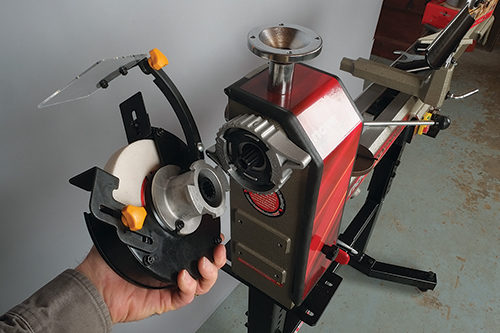
Installing NOVA's VersaTurn™ Coupler to the outboard side of the headstock allows an enclosed and guarded grinding wheel to be chop-chop bayonet locked in place. With a street toll of $135 for the 2 pieces of hardware, this puts the toll of precipitous tools where information technology should be. It'southward a corking improvement on an old thought — that now needs a CBN (cubic boron nitride) wheel to match.
Overall, the Comet Two is a smooth machine with adequate power.
Penn State Turncrafter Commander
Motor Size: 1hp
Speed: 500-1,800 / i,950-three,800 rpm
Digital RPM Display: Yes
Swing Bed/Banjo: 12″ / nine-ane⁄2″
Center to Middle Distance: 17-9⁄16″, with extension 44-9⁄xvi″
Street Cost: Lathe $650 / Ext $160 / Stand $280/ Total $i,090
Web / Phone: world wide web.pennstateind.com / 800-377-7297
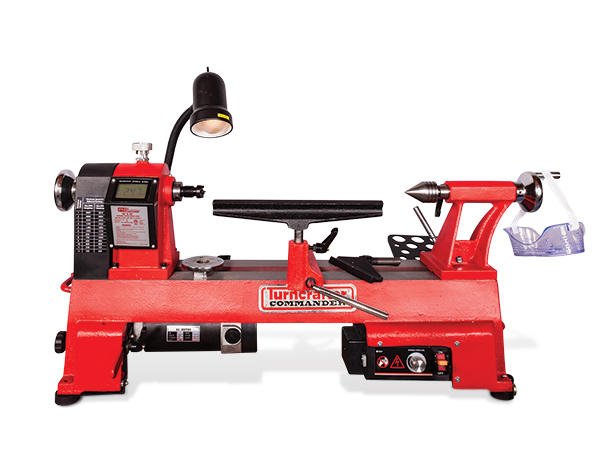
The Turncrafter Commander is one of only three lathes in this review without reverse (the others are the Rockler Excelsior and the Steelex), a characteristic I accept always considered dubious. The slight, if hundred-to-one, advantage in sanding in the opposite direction is outweighed past the danger of unscrewing a heavily laden faceplate during sanding.
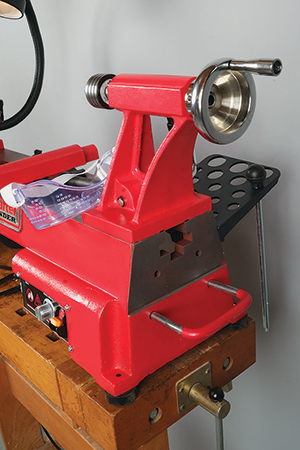
Lifting the midis in this test on and off a demote with a bed extension required ii reasonably strong people, which is why my friend and fellow turner Scott Butler helped me with assembling these lathes and their stands. A characteristic we appreciated on the Turncrafter Commander is that it had handles for easy lifting.
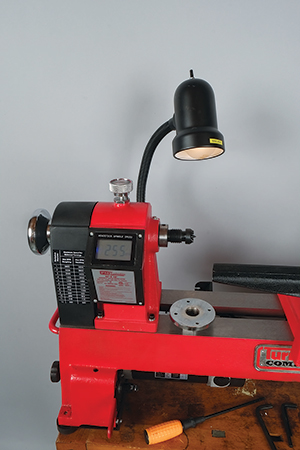
The Commander is a business firm brand of Penn State Industries, who, for the about part, sell directly. To allow UPS shipment, the bed is shipped in a split up box from the headstock, tailstock, banjo and tool-rests. This makes some associates necessary, but even the screwdriver is included. Everything bolts together in a straightforward manner with articulate instructions. The three wiring harnesses for the DC controller are easily plugged to the motor harnesses rolled up within the headstock.
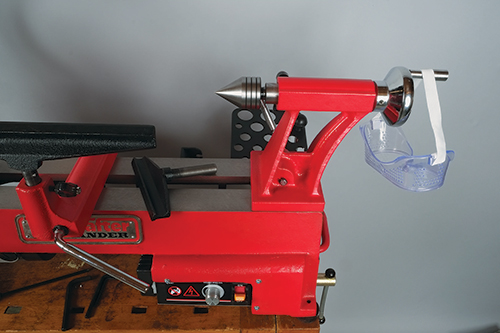
Once together, the Commander worked well with depression vibration and adequate power. I really liked the digital readout having large, easy-to-read numerals and placements on the upper face of the headstock where the turner only needs to glance over to see the speed. Too included with this lathe are a quality alive eye, a rack for accessories and a piece of work lamp — an unbelievable number of features for the price. With a bed extension, the Commander makes a peachy spindle lathe for the furniture maker with occasional turning needs.
RIKON 70-220VSR
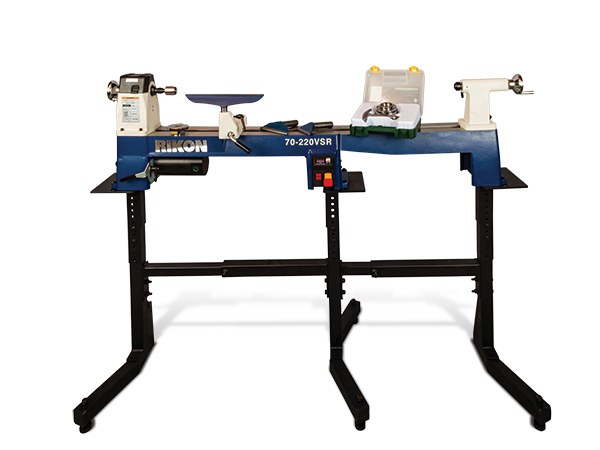
Motor Size: 1hp
Speed: 200-750 / 550-1,500 / one,300-3,850 rpm
Digital RPM Display: Yes
Swing Bed/Banjo: 12-i⁄2″ / 9-five⁄8″
Centre to Center Altitude: twenty″ / 45-three⁄8″ with Extension
Street Toll: Lathe $650 / Ext $160 / Stand up $280 / Full $1,090
Web / Phone: world wide web.rikontools.com / 877-884-5167
Except for the RIKON, lining upwards the extensions for any of the lathes in this review with the master bed is picayune, especially if working alone. An one-time trick is to get the bolts but shy of tight and marshal things as best equally possible, so slide the tailstock until its hold-downward (under the ways) equally straddles the junction between the beds. Tightening the tailstock brings both parts into perfect alignment, and the bolts joining the two parts can be bought to full torque.
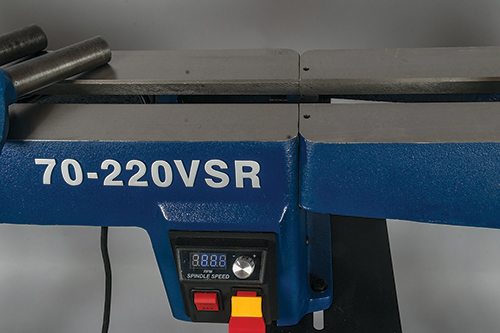
RIKON'southward lathe eliminates the demand for this fox with two grub screws in the extension bed that can now be The lifting handles on the brought tight against a ledge milled in the terminate of the chief bed, guaranteeing no-hassle perfect alignment. This is a nice characteristic for furniture builders who may want to only install the extension bed when needed and save the space at other times.
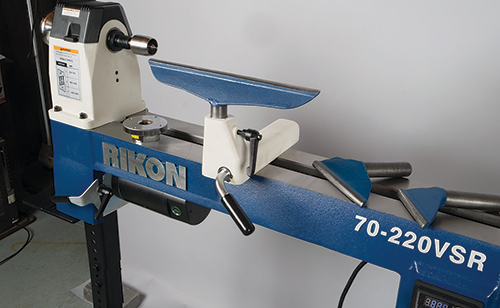
The RIKON is also ane of two lathes in this review with a 1″-diameter tool-rest (equally opposed to five/8″ for almost). This adds a huge amount of strength and stability to this most important lathe component. It also meant that I could employ the tool-rests from my total-size ONEWAY and Powermatic lathes in these machines.
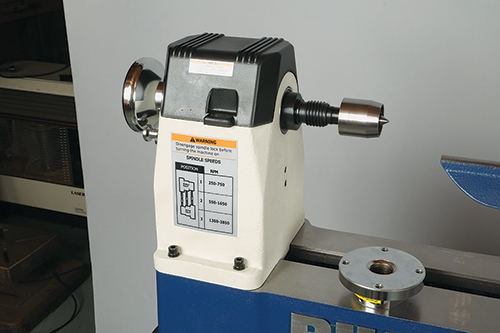
It had a very nice fit and finish with a surface-ground bed, 3-one⁄2″ quill travel and a center-to-heart distance of 20″ (45-3⁄8″ with extension) that has me over the moon. Article of furniture makers tin can turn the back posts for rocking chairs with room left over. With good ability and piece of cake controls that make this lathe a pleasance to use, if cost is a key factor for you, this lathe would be my first selection.
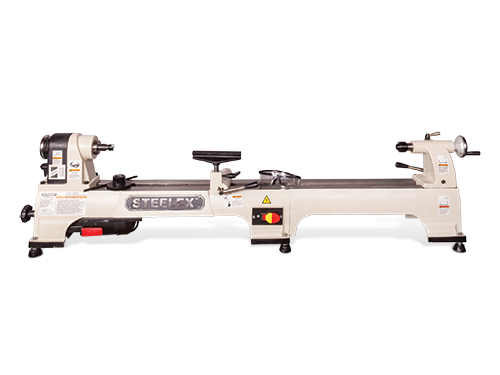
Steelex ST1008
Motor Size: 1/two hp
Speed: 480 / 1,270 / 1,960 / 2,730 / 3,327 / four,023 rpm
Digital RPM Brandish: No
Swing Bed/Banjo: 10″ / 7-1⁄two″
Center to Heart Distance: xv-13⁄16″ / 38-i⁄xvi″
Street Cost: Lathe $330 / Ext $120/ Total $450
Web / Phone: www.woodstockint.com / 800-840-8420
Grizzly supplied this lathe from their Woodstock International brand every bit their Grizzly and Shop Fox brand models were sold out and unavailable at the fourth dimension of the test. They wholesale the Steelex brand to woodworking resellers. Information technology, along with the RIKON, is ane of ii that had surface-footing beds, rather than rotary ground, which can exhibit varying degrees of smoothness. It's hundred-to-one that surface grinding makes a great deal of difference on a mini or midi lathe, simply information technology does show an involvement in quality. Surface grinding made sliding the tailstock and banjo very smooth and pleasing. The residue of the construction of this lathe is very solid as well; it's got a overnice fit and cease for its price range.
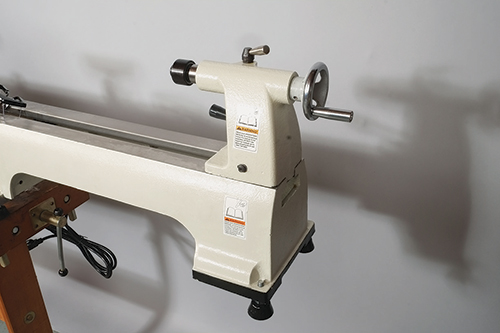
My two gripes virtually it: there is no scale on the quill, and the locking handles on the banjo striking either the bed or the tool-balance, so they need to be moved occasionally every bit situations change.
I of two mini lathes at an affordable price indicate included in this review, the Steelex is a peachy pen lathe or for a article of furniture builder with occasional turning needs.
Overall Gripes
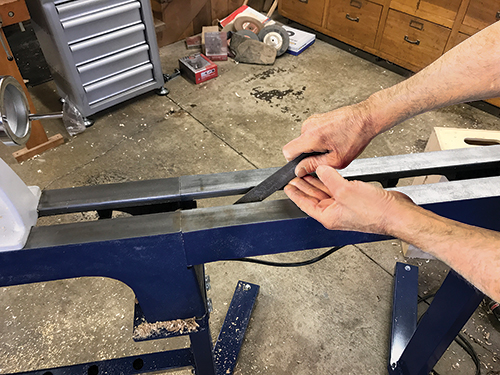
A few gripes applied to all the lathes in the review. In the by, mechanism from both Taiwan and the People's Republic of China typically had sharp edges that had to exist filed off. While this is, in general, no longer the case, the exception on all of these lathes was a sharp edge on the bottom corner of the bed ways. Non simply could this cutting you, it oft impeded polish sliding of the tailstock. It was rapidly corrected by a couple of licks from a smooth, unmarried-cut mill file.
Also, all of the banjos had commercially available steel locking levers that screwed straight confronting the tool-rest stalk. This results in Brinelling (denting/piece of work hardening of the stalk'southward surface) of the stem, which, over time, results in constant slipping of the rest if extreme torque is not practical to the lever. A cam lock would exist more than expensive, but a much improve selection.
And, sadly, none of the lathes exhibited packaging that in any mode could be termed green. Excessive plastic bags and crumbling molded Styrofoam™ were par for the course. I would urge all of these manufacturers to ameliorate the greenness of their packaging.
Place of Industry
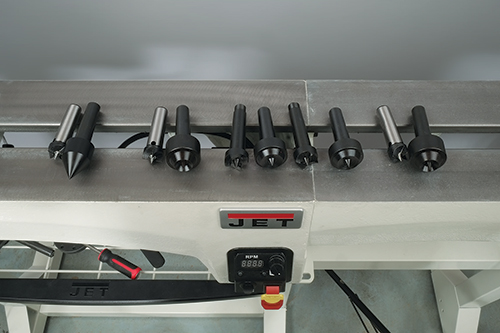
All the lathes reviewed were manufactured in Taiwan or cathay. The lathes manufactured in Taiwan showed a discernible uptick in quality, merely not then much as to make the Chinese machines at all unacceptable.
The centers supplied with all of the lathes except the COLT and the Turncrafter were virtually identical, leading me to call up that they came from simply 2 manufacturers, likely one factory in each country. The standard live center in this duo is clunky and warrants firsthand replacement. The alive centers supplied with the COLT and the Turncrafter were of much amend design and quality.
Conclusion
I am spoiled with having turned on big lathes for most of my life. While wonderful for large bowls or large spindles, it is a chore to move the big banjos when turning pocket-size items. It has been liberating to turn on smaller machines once again. You can literally flick the banjo and tool-rest to a new position with one paw. The experience has made me totally rethink big lathe snobbery.
Mini and midi lathes are commodities, and you become what you pay for. In Chevrolet versus Ford fashion, you lot become about the same quality between manufacturers at a given cost point, and spending more usually gets you lot more. It is upward to the buyer to parlay specific needs confronting automobile features. The pen turner, bowl turner and furniture maker all have different needs and will want to pull a fast one on out their lathe appropriately. The pen turner can buy a basic mini, the bowl turner will want a stout midi, and the article of furniture maker will want a mini or midi with a bed extension for generous between-middle distances.
Source: https://www.woodworkersjournal.com/review-midi-mini-lathes/

Post a Comment for "Turncrafter Commander 12 Variable Speed Midi Lathe Reviews"