Can Genetic Chromosome Testing Tell the Gender of the Baby During Pregnancy
"Prison cell-free fetal Dna testing" has contradistinct prenatal genetic testing, relying on a sample of maternal blood with no risk to the fetus
I accept 2 children. At the moment, all I know about their genes is that they both have 46 chromosomes, and one is XY and 1 is Xx.
I try to care for them equally, to presume equal potential. But what if I knew my daughter carried a "smart" cistron and my son did not? When he came home from school with a B, would I presume it was merely his genes, and not push him to attempt harder? And what if I could have known this before he were built-in, at a fourth dimension when he was just a little blip on an ultrasound? Frankly, I'm not sure I would trust myself with this data.
Such knowledge isn't, of course, possible notwithstanding. For one thing, we haven't yet institute many genes that can reliably predict intelligence. And at the moment, even if we did know what genes we were looking for, we wouldn't be able to find them very early on in pregnancy. Only thanks to a new kind of fetal genetic testing this may exist starting to change.
One time upon a time, everything about your infant was a surprise until the moment of birth. Is information technology a boy or a daughter? Does he (or she!) have all 10 fingers and x toes? And, about of import: is the babe good for you? Genetic disorders—Down's syndrome, Trisomy eighteen and others—were often a surprise in the delivery room.
We may still engage in the ritual counting of fingers and toes on our new baby, merely it's all for show: really, we checked for those months ago in an ultrasound. And for many women, genetic testing during pregnancy has ruled out—or all but ruled out—the possibility that their child has a genetic abnormality.
Recently, the introduction of "cell-free fetal DNA testing" has altered the landscape of prenatal genetic testing further. Y'all may have heard of these tests by their brand names: Harmony or MaterniT21, amid others. The technology for each is broadly the same: they rely on a sample of maternal claret with no adventure to the fetus, and they have accuracy rates approaching those of fetal diagnostic test like amniocentesis or Chorionic Villus Sampling (CVS), only without any risk to the fetus. In other words, these new tests provide the best of both worlds—and a recipe for moral fission.
The Evolution of Fetal Screening
Prenatal genetic testing, imperfect though it has been, is not new. Start in the 1970s, amniocentesis allowed doctors to identify genetic disorders in utero, typically mid-pregnancy. Within the following decade, CVS provided an alternative to amniocentesis that could be performed earlier in pregnancy—in the first trimester rather than the 2nd—and provide similar information. These ii procedures provide complete genetic information on the fetus—labs can literally sequence its entire genome.
This ways that although these are most ordinarily used to discover the nearly common genetic disorders—Down Syndrome, for case—they could, in principle, exist used to detect more pocket-size genetic abnormalities, or even to place normal genomic variations, such as a predisposition for having red pilus. (Such uses are rare, heed yous, since both procedures are invasive and deport some small run a risk to the fetus.) Historically, the alternative has been prenatal screening that relied primarily on an ultrasound, which isn't risky to the fetus but besides cannot concretely diagnose a problem, thus, they must be followed upwardly by one of the invasive procedures if a problem is suspected.
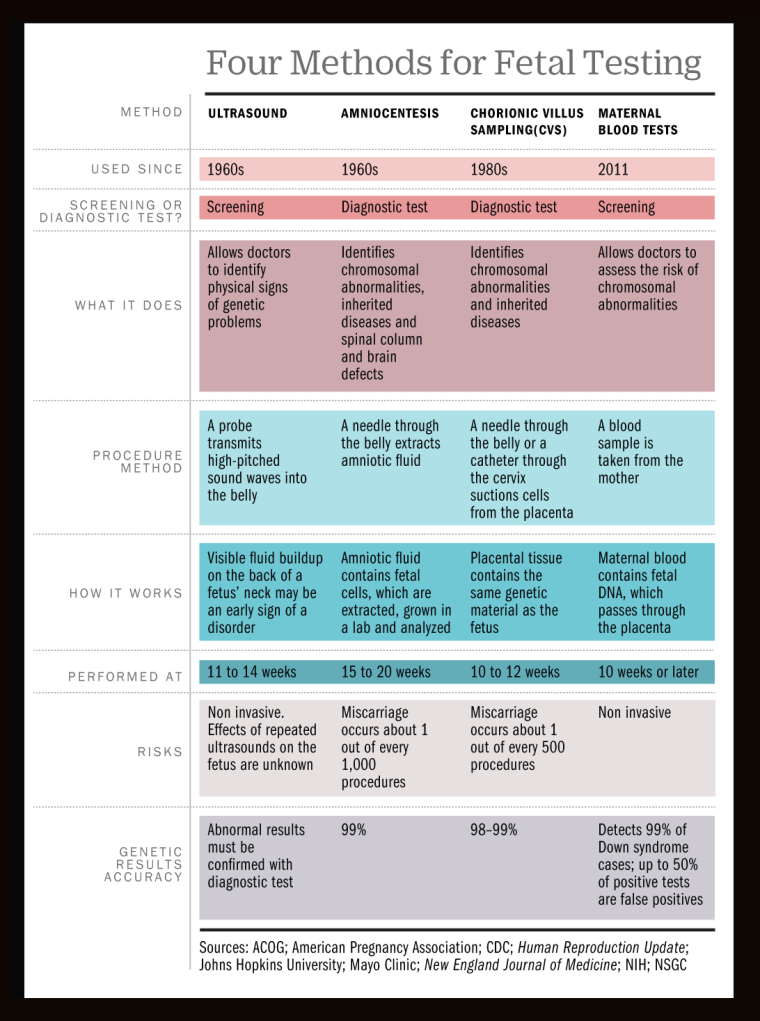
→ Enlarge Chart
The fact that we can decide characteristics of a baby in utero, combined with the availability of ballgame, has always fabricated some people nervous. It suggests eugenics, or a future of "designer babies." This is not all fanciful business: in some countries prenatal sexual activity decision and sex-selective abortion accept altered the overall sex ratios in the population (for example, in recent years in Communist china, 120 boys are built-in for every 100 girls). Simply the fact is that, in general, and in the U.Southward. in particular, prenatal screening has been effectively limited to serious genetic disorders—the run a risk of harming the fetus has outweighed the value of the information for other uses.
Simply the new prenatal screening tests are a game changer. They represent a pregnant technological breakthrough considering the key to identifying issues or genetic risks is being able to run into the baby'southward Dna. Amniocentesis and CVS attain this with amniotic fluid or placental material, both of which contain fetal cells and, hence, fetal DNA. But that means going within the womb—with a needle, typically—and actually taking some cells. And that'southward what carries the hazard.
Some fetal cells also circulate in the maternal bloodstream during pregnancy—that's not news—information technology's simply that the volume of fetal cells in maternal blood is very depression, making them difficult to use in a practical way. The technological quantum was the recognition of "jail cell-free fetal DNA"—that is, fetal Deoxyribonucleic acid outside of cells.
When prison cell-free Deoxyribonucleic acid is isolated in maternal plasma, x% to twenty% of information technology is fetal in origin. In lay terms, this ways that researchers can be confident that a large share of what they are extracting comes from the fetus. In principle, if one could simply divide the maternal and fetal Deoxyribonucleic acid, information technology would be possible to sequence the full fetal DNA using this procedure.
Technology is even so not quite at that place even so, merely this procedure currently works by looking for things in the cell-free DNA which wouldn't exist there if the DNA it were just the female parent's.
Remember about it in terms of gender: Women take ii Ten chromosomes; men accept one X and one Y. Imagine you lot expect in mom's cell-complimentary DNA and y'all observe a bunch of Y chromosomes. The baby will be a boy, right? If yous don't see any Y chromosomes, a girl.
Similarly, a fetus with Down Syndrome has three copies of chromosome 21, rather than two, but two copies of all of the other chromosomes. So if you look at a mix of fetal and maternal DNA together, from a genetically normal female parent, and encounter relatively more than copies of chromosome 21, you would suspect the baby has Down Syndrome. If any chromosomal imbalance is striking enough, the test results volition flag a potential problem.
At the moment, these tests fall brusque of what is possible with amniocentesis or CVS testing. 1 way in which they fall short is they focus on only the three most common trisomies: Down's syndrome (trisomy 21), Trisomy eighteen and Trisomy 13. Invasive testing volition discover other trisomies, and tin detect other types of chromosomal problems also. Another shortcoming: both imitation negatives and false positives are possible.
This procedure relies on a statistical threshold test: Sufficiently imbalanced, and the test pings "positive." Not sufficiently imbalanced, it comes up negative. All the same, sometimes the imbalance in the chromosome counts isn't striking enough to flag as a positive test, fifty-fifty when the baby does accept a chromosomal abnormality. This is what is called a "imitation negative." And on the other side, sometimes the chromosomes look imbalanced in the sample just the baby is fine. This is what is called a "false positive."
False negatives are pretty rare in these new claret tests—for a woman in her early 30s with a negative consequence on this screening, the chance of a babe with a chromosomal abnormality is about 1 in xc,000. False positives on this test are as well express, but they affair more. For that same woman in her early 30s with a positive test result, the chance of having a baby with a chromosomal problem is about 66%. In other words, 1 out of three women who receive results indicating abnormalities will really have a baby who is genetically normal.
Answering—and Raising—More Questions
Experts agree that consequential decisions about a pregnancy should not be fabricated without an invasive examination equally a follow-upward. But this is likely to be a temporary consequence. Effectively, the problem is ane of genetic sequencing capacity and statistics. Already these tests are close to perfect on detection of gender. And the precision with which genetic predictions can be made will likewise ameliorate. Information technology seems unlikely we are more than than a few years away from the ability to utilize these tests every bit diagnostic.
Every bit these tests improve, then too will the range of weather condition they can find. Researchers last year reported on a case in which they used a version of this test to detect a small genetic issue called a microdeletion. The bear on of this microdeletion, which was passed on from the mother, is an increased take a chance for nearsightedness and mild hearing loss. The mother in the study learned that she was passing on her poor eyesight and bad hearing to her kid.
In principle, this applied science could be used to detect anything for which we have a known genetic link. Researchers engaged in Gene-Wide Association Studies (GWAS) have, in the by few years, made progress on identifying a few genes which code for intelligence. Imagine you've tested yourself and yous know y'all carry ane of these intelligence genes but, sadly, your spouse does not. Now imagine you tin easily learn if your fetus got your smart genes, or your spouse'south non-so-smart ones. Or your genes for height, your risk for obesity, and your spouse'south gene for stubbornness (okay, we haven't plant this 1 even so).
Now have it a step further. Fetal DNA begins to circulate in the mother'due south blood at the very start of pregnancy. At the moment, these tests wait until 10 or eleven weeks of pregnancy and so the concentration of fetal Dna is high enough to use for accurate detection. But as the sequencing and statistics amend, we may find that it is possible to do the aforementioned testing at 8 weeks. Or six.
What if you could know, at six weeks of pregnancy, whether your kid would inherit your height, or hair color, or IQ? As I mentioned before, early on gender testing is already used for gender-selective abortion, largely outside the U.Due south. This was true even when gender detection was not possible until 18 or twenty weeks.
These technologies will raise questions far beyond gender. Many people terminate a pregnancy when they larn the fetus has Downwardly Syndrome. What near learning that the child volition have autism? Or only that their IQ is likely to exist below average? We are belongings Pandora's box. Once we open it and permit the information out, nosotros lose control over what information technology is used for.
I would argue there are farther implications. Let's say I notice out my fetus has an increased genetic risk for obesity, and I ultimately have that child. How volition I treat her? Will I obsess near everything she eats, every ounce of babe fat that doesn't immediately cook away? Will she grow upwards to be obese, or have an eating disorder I was party to with my worry? Could this actually make things worse rather than meliorate? The idea that more information is improve relies on our ability to ignore it. Simply is this something that, every bit a parent, yous could always really ignore?
I'm trained equally an economist, and i of our general principles is that more data is amend. Data helps usa make ameliorate—more optimal—decisions. And, crucially, more information cannot make yous worse off, since y'all can always just ignore information technology. Nether this theory, these advances in genetic testing should be welcomed without reservation.
In many dimensions, the improvements in testing bring but good. The ability to more accurately detect serious genetic conditions earlier in pregnancy allows women and their partners to brand difficult decisions virtually pregnancy termination earlier in the pregnancy when the medical complications are less meaning.
The balance between the values of information and the possibility of mis-apply is a difficult one. It would be a shame to fail to pursue technologies that are probable to evangelize groovy gains. At the aforementioned time, information technology is naïve to pursue them without thinking well-nigh their consequences. And nosotros should start thinking about these now.
Ready or not, the hereafter is coming.
Emily Oster is a professor of economics at Dark-brown Academy and the author of Expecting Improve
Source: https://time.com/expectingbetter/

Post a Comment for "Can Genetic Chromosome Testing Tell the Gender of the Baby During Pregnancy"