Hierarchical Encoding Makes Individuals in a Group Seem More Attractive Review
Introduction
Barney Stinson, a main character in the television receiver series How I Met Your Mother, hypothesized that people are perceived as existence more attractive in a group than when perceived individually; he chosen this phenomenon the cheerleader consequence. Walker and Vul (2014) introduced this term into scientific discourse and provided the first empirical bear witness for the result.
The cheerleader effect has been replicated several times (Carragher et al., 2018, 2019; Ying et al., 2019), and several human data processes predict this effect. While initial work assumes that visual retentiveness processes could cause the cheerleader effect (Walker and Vul, 2014), contempo research adds that the cerebral processes of judgment and controlling could also cause cheerleader effects (Ying et al., 2019).
The aim of this article is to introduce a farther cognitive procedure that could cause a cheerleader consequence. Evaluation of an private face can only exist based on a comparison with the viewer'southward internal standard, while evaluation of a face in a group can exist based on contrast with other faces. This change in the evaluation way can cause a cheerleader effect even if there is no dissimilarity between the bewitchery of the target face and the flanking faces. If a face of low attractiveness is compared to an internal standard, it appears less attractive than when it is compared to other faces of low attractiveness. Therefore, fifty-fifty if at that place is no contrast betwixt the attractiveness of the target face and the flanking faces, a cheerleader result could sally.
Evidence that a modify in evaluation style could crusade a cheerleader effect does not hateful that the other processes are false. Rather, in specific situations, the evaluation mode could predict a cheerleader effect that could not be explained by one of the other processes. At the end of this article, nosotros discuss situations which could foster i of the other processes to cause cheerleader furnishings. The aim of this article is not to falsify culling processes, but to provide initial evidence that a change in evaluation mode could crusade a cheerleader consequence.
We chose a design in which four theories differ in how they predict the cheerleader issue, and we chose a situation that corresponds to a real-time situation, one where an observer sees an unknown person for the start fourth dimension. This has some relevance, for case, for people who determine to post a selfie on social media. The question is whether faces are perceived as more attractive in isolation or together with flanking faces. Furthermore, we want to investigate if it matters if the flanking faces are less, equally, or more than bonny than the target confront.
Cheerleader Outcome
The attractiveness of a face is influenced non just past its facial features (Fink and Penton-Voak, 2002; Said and Todorov, 2011), just also by other faces seen previously (Ying et al., 2019) or simultaneously (Walker and Vul, 2014; Carragher et al., 2018, 2019). The latter produces what is called the cheerleader upshot. While some studies have failed to replicate the cheerleader consequence (van Osch et al., 2015), others take successfully reproduced information technology (Carragher et al., 2018, 2019; Ying et al., 2019).
Some boundary conditions of the cheerleader issue accept been tested in recent studies. The cheerleader outcome occurs in natural group settings (Walker and Vul, 2014), in unmarried pictures of faces (Walker and Vul, 2014), and with computer-generated faces (Ying et al., 2019). Neither the size of the group (Walker and Vul, 2014) nor the position of the target face up (Carragher et al., 2018) moderate the cheerleader effect; all the same, the bewitchery of the flanking faces plays a moderating part: the less bonny the flanking faces, the greater the cheerleader event (Ying et al., 2019).
Prior research suggests that visual retentiveness processes could cause the cheerleader consequence (Walker and Vul, 2014). Langlois and Roggman (1990) contend that averaging visual information could cause a cheerleader result, because averaging increases the attractiveness of faces. This would predict that any target faces would be evaluated as more bonny when flanked by other faces than in isolation. Another visual memory process is hierarchical encoding, which could also predict a cheerleader event, but just when faces are flanked by more attractive faces. Hierarchical encoding describes the process whereby data in the visual working retentiveness is not stored independently but is synthetic into a higher-order representation (Vogel et al., 2001; Luck and Vogel, 2013; Im and Chong, 2014; Oriet and Hozempa, 2016). Observers could encode a group of attractive faces as an attractive group. Less attractive faces within this group would turn a profit from this hierarchical encoding and be perceived equally more than attractive. As a upshot, hierarchical encoding leads to a bias toward the hateful. If an individual is shown an image containing several blue and blood-red circles, wherein the blue circles are mostly large and the carmine circles more often than not minor, then a medium-size circumvolve is remembered as existence larger when information technology is blue than when it is blood-red (Brady and Alvarez, 2011). In other words, the recall of individual items is biased toward the grouping hateful, so faces are perceived equally beingness more attractive when flanked by other more attractive faces than when perceived in isolation. Less attractive target faces may be expected to profit more from highly attractive flanking faces than highly attractive target faces would. When faces are flanked past faces of depression attractiveness, hierarchical encoding would pb ane to expect a reverse cheerleader effect: faces will be perceived as more attractive in isolation than when accompanied past other faces. If the attractiveness of the target face is equal to the hateful of the flanking faces, hierarchical encoding would predict no event.
Ying et al. (2019) introduced a cerebral attribute to the cheerleader effect's theoretical caption, suggesting that contrast effects cause the cheerleader effect. The attractiveness of the flanking faces is the standard of comparing for the bewitchery of the target face. Ying et al. (2019) argue that the contrast betwixt the flanking confront's attractiveness and that of a target face boosts the perceived attractiveness in the reverse direction. This leads to the prediction that a target face is perceived equally more attractive when information technology is flanked by less attractive faces. Thus, the relative differences between the target face and the flanking faces cause the event. If there is no difference between the bewitchery of the target face and the flanking faces, the perceived attractiveness of the target confront should not change.
Change in the Evaluation Fashion Between Dissever vs. Articulation Evaluations
The aim of this article is to refine this cognitive view with a change in the evaluation mode of joint and split evaluations (Hsee and Leclerc, 1998; Hsee and Zhang, 2010). The example of purchasing a watch illustrates this change in the evaluation mode: if potential buyers are offered only a single spotter, they volition use internal information to build their impressions of the watch's value. However, when buyers are offered several watches, they can compare these watches. This leads to a modify in the evaluation fashion. Now, the relative differences among the watches is relevant for the evaluation. The internal standard plays a crucial role. Watches below the internal standard will profit from this change in evaluation mode even when they are compared to equal or superior watches, as long equally the alternatives are yet beneath the internal standard. The contrary happens with watches to a higher place the internal standard. They do not turn a profit when compared with other watches above the internal standard, because the relative difference betwixt watches above the standard is less than the deviation from the internal standard. Therefore, it is wise to present luxury products separately and junior products jointly (Hsee and Leclerc, 1998). In a similar way, a modify in evaluation style could cause the cheerleader effect. The evaluation of the attractiveness of an private face is based on internal standards. The evaluation of the attractiveness of a face in the context of flanking faces is based on comparison with the flanking faces. The bewitchery of a face increases if the accompanying are less attractive than the internal standard. This leads to the prediction that faces of depression attractiveness should turn a profit from flanking faces, even when there is no difference between the attractiveness of the target face and that of the flanking faces.
The change in evaluation way is a farther process which could cause a cheerleader effect. The contrast model and the change in evaluation mode practise not contradict each other. The modify in evaluation mode complements the contrast model and offers a farther caption for how a cheerleader outcome could emerge. According to this theory, individual faces are evaluated in contrast to an internal standard. Even so, if flanking faces are available, target faces are evaluated in dissimilarity to the flanking faces. Now two processes could cause a cheerleader effect. Information technology is possible that the contrast betwixt the target face up and the flanking faces causes a cheerleader effect. In add-on, it is possible that the change in evaluation mode, from internal standard to flanking faces, is another possible cause for this effect.
In sum, the four explanations differ in their predictions concerning the influence of the target face'south attractiveness on the cheerleader effect. Figure 1 illustrates the differences. Averaging predicts that the bewitchery of faces ever increases when they are flanked past other faces. Hierarchical encoding holds that the cheerleader outcome ensues when faces are flanked by more attractive faces. The contrast effect and the alter in evaluation style posit that merely flankers of low attractiveness bring virtually the cheerleader outcome; withal, they differ in their predictions when in that location is no contrast between the bewitchery of the target face and the flanking faces. Without any divergence between the attractiveness of the target face and that of the flanking faces, the contrast consequence would predict no cheerleader effect; all the same, the change in evaluation manner predicts that less attractive target faces turn a profit from equally less bonny flanking faces. Thus, even without any contrast betwixt the attractiveness of the target face and the flanking faces, a cheerleader effect should occur.
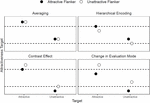
Figure 1. Predictions of target confront bewitchery. This figure illustrates that the four theories differ in their predictions of how the attractiveness of a target face up changes when it is flanked by other faces. The dashed lines represent the ratings of the attractive and unattractive faces when they are not flanked. The circles indicate the ratings of the flanked faces. Averaging visual information leads to increased perceived attractiveness, regardless of the attractiveness of the target and flankers compared to the unflanked target. According to hierarchical encoding, visual information is stored in college-gild representations. The rating of the target depends on this representation and drifts to the hateful rating of all simultaneously presented faces. The dissimilarity effect states that the flanking faces provide the standard of comparison for the target faces. If this standard is depression, the target is rated as more attractive and vice versa. Presenting a target with flankers rather than in isolation leads to a alter in the evaluation mode. The target is no longer compared to the internal standard; instead the departure betwixt target and flankers becomes of import. If there is a dissimilarity between target and flankers, the rating becomes more extreme; if there is no contrast, the rating becomes more moderate. This figure demonstrates that the four theories differ in their predictions of how the bewitchery of a target face up changes when it is flanked past other faces.
Consequently, a study in which target face attractiveness and flanking faces' attractiveness are manipulated independently would provide show of the processes underlying the cheerleader effect.
Two Research Traditions
The cheerleader result has mainly been studied by cognitive psychologists, whereas the evaluation fashion has been mainly studied past behavioral scientists. Every bit a result, the research traditions differ in their units of assay. In cognitive psychology, faces provide the unit of measurement of assay. A few participants charge per unit many faces in a within-bailiwick design and ratings for each face are aggregated. The cheerleader effect is calculated by analyzing a sample of faces. In behavioral science, the units of ascertainment are typically participants, and often in a between-subject field design. In the case of the cheerleader effect, both strategies are possible. All the same, they differ in the estimation. Focusing on faces provides an impression of the variance of face up attractiveness when adding flanking faces. Focusing on participants gives an impression of the variance of human judgments when adding flanking faces. Studies of the cheerleader effect have typically analyzed faces as units of ascertainment. For this reason, nosotros did this likewise. However, we decided that each face should be rated by each participant merely in one case. This corresponds to a situation where an observer evaluates an unfamiliar face up for the kickoff time. In this regard we differ from previous studies that have investigated the cheerleader outcome.
Materials and Methods
Sample Size and Disclosure Statement
The sample size was determined earlier any data analysis was carried out. Because some studies have replicated the cheerleader consequence (Carragher et al., 2018, 2019; Ying et al., 2019) while others failed to practise then (van Osch et al., 2015), it is inappreciably possible to estimate the result size. A recent study (Ying et al., 2019) used half-dozen faces, which were evaluated by xx participants. In this study, the number of evaluated faces was increased to 24 and we decided to recruit 600 participants. The study was conducted with more participants than those of quondam studies because in this study, each participant only rated 12 different faces and each face only once. This corresponds to a situation where an observer evaluates an unfamiliar face for the start time. Thus, the bewitchery of each face up in each condition was rated by at least 94 participants.
Participants
The participants were all United States residents and were contacted via Amazon Mechanical Turk. A total of 605 participants completed the study; 19 failed to laissez passer an attention bank check and were dismissed. Of the remaining 586 participants, 240 were female, 343 were male person, and three identified as non-binary. The mean age was 37.16 (SD = 11.23, range = 18–73).
Blueprint
The study used a 3 (Flankers) × ii (Targets' attractiveness) mixed factorial design. Each face was rated without flanking faces, with highly attractive flanking faces, and with low attractive flanking faces. In addition, the targets' bewitchery was manipulated: half of the participants were shown only highly attractive targets, while the other half were shown only targets of depression attractiveness. Notation that the highly bonny target faces did not differ in their bewitchery from the highly attractive flanker faces. Likewise, the target faces of low attractiveness did not differ in their attractiveness from the flanking faces of low bewitchery. The guild in which the faces appeared was balanced, as was the side on which the flankers were presented. The status assignment was random.
A sensitivity power analysis for the mixed model ANOVA, with an alpha significance criterion of 0.05 (two-tailed), a standard power criterion of 0.viii for two groups (Targets' bewitchery), and three repeated measures (Flankers) that highly correlate (r = 0.98), yielded an consequence size of F = 0.054 (η2 = 0.22) for 24 faces. A sensitivity ability assay for the t-tests, with an alpha significance criterion of 0.05 (two-tailed) and a standard power criterion of 0.viii for matched pairs, yielded an result size of d = 0.89 for 12 faces.
Process and Materials
Dependent Variable
After participants provided their informed consent, they were instructed to charge per unit the attractiveness of the confront in the centre of the screen on a scale from 0 (not at all attractive) to 100 (extremely attractive). Each participant rated 12 faces. For each confront, the mean attractiveness rating served as the dependent variable. The participants were shown faces from the Chicago Face up Database (Ma et al., 2015), which contains highly standardized pictures grouped according to gender, historic period, and race. All faces are depicted from a frontal perspective and accept a neutral facial expression. For each face, there is an attractiveness rating, which allows for a selection of faces of the same gender and race and of similar attractiveness. Twenty-four sets of faces containing iii faces that did not differ in gender or race (White, Hispanic, African–American, and Asian) and that were similar in their attractiveness were selected. Half of the faces were male person and half female.
Attention Check
Typically, online experiments contain an attention cheque to filter out participants who did not read the instructions carefully. After measuring the dependent variable, participants were shown a movie of a dog'south face and instructed to click on a scale from 0 to 100, just just within the range of 20–30. This served as an attention check.
Manipulation Bank check
Later on the attention check, participants rated the bewitchery of the flankers. To compare the flankers with the target faces with regard to attractiveness, only data from participants who had previously evaluated targets without flankers were analyzed, so that they evaluated the flankers' facial attractiveness viewing them for the start fourth dimension.
Farther Measure
Following the manipulation check, the participants rated the bewitchery of i thespian and one actress. As these data are not relevant for this article, they are non included in the results. Finally, the participants answered demographic questions.
Results
Manipulation Bank check
The manipulation of the targets' attractiveness was successful. All the analyses were based on evaluations of faces that were presented in isolation. The targets of high attractiveness (M = 58.44, SD = 10.71) were more attractive than the targets of low attractiveness (Chiliad = 39.10, SD = 4.69), t(22) = 5.73, p < 0.001, Cohen's d = ii.34.
The attractiveness of the flanking faces corresponded to the target face attractiveness: the targets of high bewitchery (Grand = 58.44, SD = 10.71) were as attractive every bit the highly attractive flankers (Thousand = 58.28, SD = 9.08), t(11) < 1, p = 0.94, Cohen's d = 0.02. Likewise, the targets of low attractiveness (Thou = 39.1, SD = four.69) were every bit attractive equally the flankers of depression attractiveness (One thousand = 37.81, SD = 4.13), t(11) < ane, p = 0.37, Cohen's d = 0.27.
Main Results
An ANOVA of the between-subjects gene targets (high vs. low attractiveness) and the repeated measures flankers (without flankers, low attractiveness, and high attractiveness) revealed a main effect of the targets F(1,22) = 42.81, p < 0.001, η2 = 0.66, a main upshot of the flankers, F(2,44) = 99.2, p < 0.05, η2 = 0.05, and an interaction F(2, 44) = xx.71, p < 0.001, η2 = 0.01. Due to the manipulation, the targets of loftier attractiveness (Thou = 59.79, SD = 9.32) were more attractive than the targets of depression attractiveness (Thousand = 40.28, SD = 4.45), t(22) = 6.53, p Bonferroni < 0.001, Cohen'southward d = 1.33. The manipulation of the flankers resulted in a cheerleader effect. The target faces were perceived as more than attractive when flanked by faces of depression attractiveness (M = 53.77, SD = 10.51) than when they were non flanked (M = 48.77, SD = 12.77), t(23) = eight.34, p Bonferroni = < 0.001, Cohen'south d = i.lxx. In addition, target faces were perceived as more attractive when flanked by faces of low attractiveness (M = 53.77, SD = 10.51) than when they were flanked by faces of high attractiveness (Chiliad = 47.55, SD = 13.68), t = 7.91, p Bonferroni < 0.001, Cohen's d = 1.61.
This result was moderated past the targets' attractiveness. The direction of the moderation was in line with the predictions of the change in evaluation mode. Figure 2 illustrates the results. The cheerleader effect emerged when in that location was no difference betwixt the attractiveness of the target and that of the flanking faces. The target faces of low attractiveness (M = 39.10, SD = 4.69) were evaluated every bit more bonny when they were flanked past faces of equally depression bewitchery (1000 = 45.48, SD = four.84), t(22) = 9.64, p Bonferroni < 0.001, Cohen'due south d = i.97.
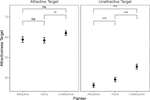
Effigy 2. Changes in the attractiveness of faces of low and loftier bewitchery due to flankers of low and loftier attractiveness. This figure illustrates the changes in the hateful and the 95% conviction interval in the attractiveness of target faces of low and loftier attractiveness when they are not flanked, and when they are flanked by faces of low or high attractiveness (ns = not significant; * < 0.05; ** < 0.01; *** < 0.001).
In line with contrast effects and change in evaluation mode the faces of high attractiveness were in a contrast to the flankers with low bewitchery. The faces of high bewitchery without flanking faces (M = 58.44, SD = 10.71) were more bonny when they were flanked by faces of low attractiveness (Yard = 62.06, SD = seven.59), t(22) = 5.47, p Bonferroni < 0.001, Cohen's d = one.12 (which is smaller than that of faces of low attractiveness, t(22) = ii.threescore, p = 0.xx).
A reversed cheerleader result emerged when the faces of low attractiveness (Grand = 39.ten, SD = iv.69) were flanked by the faces of high attractiveness (G = 36.25, SD = 4.05), t(22) = 4.30, p Bonferroni < 0.001, Cohen's d = 0.88. This is in line with the predictions of the contrast event and the change in evaluation fashion. However, no changes emerged when the faces of high attractiveness (M = 58.44, SD = x.71) were flanked by the faces of high attractiveness (M = 58.85, SD = 9.81), t(22) < i.00, p Bonferroni = 0.54, Cohen's d = 0.xiii. This is in line with the predictions of the contrast effect and hierarchical encoding.
Additional Analysis
Although there are no significant differences between the targets and flanker's attractiveness if they are either both highly attractive or both less attractive, there are still minimal contrasts. Since we used different faces for the target and the flankers, there are e'er some minimal differences between the target and the flankers in terms of attractiveness. So, at that place may still exist contrast furnishings betwixt high bonny targets and high bonny flankers, or unattractive targets and unattractive flankers. To investigate if those minimal contrasts arouse cheerleader furnishings, we calculated the correlations of the contrasts between targets and flanker'due south attractiveness with the cheerleader outcome.
We did not detect whatever correlation between the hateful contrast betwixt target and flankers and the cheerleader event for bonny faces, r(10) = 0.04, p = 0.xc, unattractive faces r(10) = 0.twenty, p = 0.54, or pooled together r(22) = −0.22, p = 0.30.
Yet, we found correlations betwixt the contrast and the cheerleader effect for attractive faces flanked by unattractive faces r(10) = 0.86, p < 0.001 and for unattractive faces flanked by bonny faces r(10) = 0.66, p < 0.05.
Word
The goal of this written report was to demonstrate that a change in evaluation manner could cause a cheerleader issue. The results show that faces are perceived as more attractive when they are flanked by faces of low rather than loftier attractiveness, even when the target faces do not differ in bewitchery from the flanking faces. This is in line with the predictions of the alter in evaluation mode and that the presence of flanking faces changes the evaluation mode (Hsee and Leclerc, 1998; Hsee and Zhang, 2010).
Contrast Result and Evaluation Mode
The dissimilarity hypothesis and the evaluation mode practice not contradict each other. Both theories argue that judgments are constructed past contrasts. When flanking faces are bachelor, target confront attractiveness is evaluated in contrast to flanking faces. The contrast betwixt the target face up and the flanking face could cause a cheerleader effect (Ying et al., 2019). However, if no flanking faces are bachelor, observers base their judgment on the contrast with their internal standards (Hsee and Zhang, 2010). This change from an external to an internal standard of comparison could crusade a cheerleader effect as well. In our experiment, nosotros minimized the contrast betwixt the target faces and the flanking faces. In the condition with unattractive targets flanked past equally unattractive flankers, we observed a cheerleader effect.
In our experiment, we had no straight measure of the change in evaluation mode. Our argumentation is based on the idea that a contrast between target and flanking face bewitchery is a necessary condition for a contrast issue. Therefore, we selected targets and flankers which are very similar in their caste of attractiveness. Notwithstanding, minimal contrasts between target and flanking confront attractiveness however exist. Therefore, nosotros cannot rule out the possibility that minimal contrasts cause the cheerleader effect in those weather condition likewise. Nonetheless, in that location are boosted results which support our hypotheses. First, when considering faces with low attractiveness with every bit low attractive flanking faces the cheerleader effect is greater than when considering highly attractive faces with unattractive flanking faces, although the contrasts are smaller. Second, we calculated the difference betwixt the attractiveness of each target face with every bit attractive flankers (minimal contrasts) and with more or less bonny flankers respectively (high contrast). In both conditions with high contrast there was a correlation between the contrast and the cheerleader effect. However, in both conditions with minimal contrast at that place was no correlation between the dissimilarity and the cheerleader effect.
The aim of this paper is to introduce the idea that a alter of evaluation mode is a process which could crusade a cheerleader effect. Falsifying other processes is not an aim of this paper. Really, fifty-fifty small changes could cause other processes to influence the evaluation of facial attractiveness.
Real-Time Rating vs. Memory
This written report focused on existent-time impressions and not on memory-based judgments. Therefore, the participants rated the attractiveness of faces online while these faces were in view. Nevertheless, real-time ratings differ from memory-based judgments (Hastie and Park, 1986; Ying et al., 2020). It is possible that visual memory processes have a higher influence on attractiveness ratings when judgments are retentivity-based but not when they occur in real time. In a recent study, participants evaluated faces afterwards they had disappeared from the screen (Ying et al., 2019). Although the interval was short, the participants gave memory-based judgments. Ying et al.'southward results could exist interpreted as a mix between cognitive and visual memory processes because they show that facial bewitchery was more favorable when faces were flanked by faces of both low and high attractiveness.
Simultaneous and Sequential Presentation of Faces
Similar to memory-based judgments are situations where people evaluate a face online and compare it with a formerly viewed face. Such situations adjure to two opposing influences: on the ane hand a face is rated as more than attractive when it follows a face of depression attractiveness (Pegors et al., 2015; Ying et al., 2019), while on the other hand a face is rated as more than bonny when a face of high bewitchery precedes information technology (Pegors et al., 2015). Therefore, judgments of the perceived attractiveness of flanked faces may differ when they are recalled compared to when they are made in real time. In add-on, there is evidence that the cognitive processes differ if the observer evaluates a group of faces simultaneously or sequentially (Ying et al., 2020).
First Impressions vs. Familiar Faces
One important limitation of our study concerns the familiarity of the faces. Similar to other studies of the cheerleader upshot, we measured the attractiveness of faces that were unfamiliar to the participants. Therefore, our results are based exclusively on the kickoff impression of these faces. The precise mechanisms by which the attractiveness of a familiar face is influenced by flanked faces remains to be determined. Nonetheless, attractiveness judgments are not only influenced by concrete aspects but also past psychological aspects, such as associations (Rhodes and Zebrowitz, 2002) or sentimental feelings (Yang and Galak, 2015). Information technology is possible that the more than an attractiveness rating is influenced by psychological aspects, the less it is influenced by flanking faces.
Highly Attractive Flankers
It seems that a reversal of the cheerleader result is less likely to occur than the cheerleader event. In the nowadays study, we found a reversal of the cheerleader effect when target faces were flanked past highly attractive faces simply for target faces of low attractiveness, merely not when highly bonny target faces were flanked by equally highly bonny faces. Similarly, Ying et al. (2019) reported cheerleader furnishings and no reversal of the cheerleader effect even when the flankers were attractive. One possible caption is that in improver to cognitive processes, additional processes, such as averaging in the visual retentivity, by and large increase facial attractiveness in groups.
Extremely Attractive Faces
A further limitation pertains to extremely attractive faces. Nosotros did not use extremely attractive faces. The potential to increase the allure of extremely attractive faces is limited. Therefore, due to the ceiling effect, one would expect no or minimal cheerleader effects for extremely bonny people. In addition, if a person is unambiguously bonny, like Scarlett Johansson or Chris Hemsworth, observers do not need additional data to build their impressions. They accept sufficient information for their evaluation, volition not contrast them to flanking faces, and volition not sample additional information (Simon, 1955; Fiedler and Bless, 2010; Stüttgen et al., 2012). However, for people with more ambiguous levels of attractiveness, such every bit John C. Reilly or Rebel Wilson, observers will consider the attractiveness of flanking faces (Messner, manuscript in grooming).
Assimilation vs. Contrast
Judgments are not e'er formed in contrast to something; they can exist formed in assimilation toward something also (Sherif et al., 1958; Mussweiler, 2003; Bless and Schwarz, 2010). Assimilation corresponds to the thought of hierarchical encoding. An caption of the cheerleader effect based on hierarchical encoding is based on two assumptions: First, observers calculate the mean attractiveness of faces they run across simultaneously; second, observers differentiate between the target face up and other faces and bias their evaluation of the attractiveness of the target face toward the main attractiveness of the grouping of other faces. While evidence for the commencement assumption exists (Luo and Zhou, 2018), no such evidence exists for the second assumption (Luo and Zhou, 2018; Carragher et al., 2019; Ying et al., 2019). All the same, it is possible that additional back-up would facilitate differentiation between the target face and the flanking faces and foster hierarchical encoding.
Decision
The change in evaluation mode has a loftier touch on on marketing practice. A seller of low-budget products (east.g., a cheap-looking lookout man) presents the products alongside other low-budget products (other inexpensive-looking watches), while the seller of luxury goods presents the products separately (Hsee and Leclerc, 1998). This article provides prove that similar processes are relevant for self-marketing, assuming the goal is that observers evaluate ane's attractiveness highly when one posts selfies on social media. Ane appears more bonny in a selfie with other people than in isolation, as long as the other people are equally or less attractive. The higher ane's own attractiveness, the less one benefits from this consequence; nevertheless, it is not benign to post a selfie taken with other people in the frame if the attractiveness of these other people is high. Finally, the more unambiguous one's attractiveness, the less one is affected by flanking faces.
Data Availability Statement
The datasets presented in this report can be plant in online repositories. The names of the repository/repositories and accession number(southward) can be institute below: the material and the information are bachelor at https://osf.io/qhjxs/?view_only=0d857d0514604aeca912a3202ee3c74f.
Ethics Statement
The studies involving man participants were reviewed and canonical by Ideals Committee of the Faculty of Business, Economics, and Social Science of the University of Bern (Project Number: 102019). The patients/participants provided their written informed consent to participate in this study.
Author Contributions
All authors contributed to the report design, analyzed the information and approved the final manuscript. CM wrote the manuscript. MC and PH contributed their input.
Conflict of Interest
The authors declare that the research was conducted in the absenteeism of any commercial or financial relationships that could exist construed as a potential conflict of involvement.
References
Anoint, H., and Schwarz, N. (2010). Affiliate Half-dozen: mental construal and the emergence of assimilation and dissimilarity effects: the inclusion/exclusion model. Adv. Exp. Soc. Psychol. 42, 319–373. doi: 10.1016/S0065-2601(x)42006-7
CrossRef Total Text | Google Scholar
Carragher, D. J., Lawrence, B. J., Thomas, N. A., and Nicholls, M. E. R. (2018). Visuospatial asymmetries do not attune the cheerleader result. Scient. Rep. 8:2548. doi: 10.1038/s41598-018-20784-5
PubMed Abstruse | CrossRef Total Text | Google Scholar
Carragher, D. J., Thomas, Northward. A., Gwinn, O. S., and Nicholls, Thousand. East. R. (2019). Limited bear witness of hierarchical encoding in the cheerleader consequence. Scient. Rep. 9:9329. doi: 10.1038/s41598-019-45789-6
PubMed Abstruse | CrossRef Full Text | Google Scholar
Fiedler, Chiliad., and Bless, H. (2010). "The formation of behavior at the interface of affective and cognitive processes," in Emotions and Behavior, ed. Grand. P. Zanna (Cambridge University Press), 144–170. doi: 10.1017/cbo9780511659904.006
CrossRef Full Text | Google Scholar
Fink, B., and Penton-Voak, I. (2002). Evolutionary Psychology of Facial Attractiveness. Curr. Directly. Psychol. Sci. eleven, 154–158. doi: 10.1111/1467-8721.00190
CrossRef Full Text | Google Scholar
Hastie, R., and Park, B. (1986). The relationship between memory and judgment depends on whether the judgment task is retentiveness-based or on-line. Psychol. Rev. 93, 258–268. doi: 10.1037/0033-295X.93.3.258
CrossRef Full Text | Google Scholar
Hsee, C. Thou., and Leclerc, F. (1998). Volition Products Look More than Bonny When Presented Separately Or Together? J. Consum. Res. 25, 175–186. doi: 10.1086/209534
CrossRef Full Text | Google Scholar
Langlois, J. H., and Roggman, L. A. (1990). Attractive faces are merely boilerplate. Psychol. Sci. ane, 115–121. doi: 10.1111/j.1467-9280.1990.tb00079.10
CrossRef Full Text | Google Scholar
Luck, S. J., and Vogel, E. K. (2013). Visual working memory capacity: from psychophysics and neurobiology to individual differences. Trends Cogn. Sci. 17, 391–400. doi: 10.1016/j.tics.2013.06.006
PubMed Abstract | CrossRef Full Text | Google Scholar
Ma, D. South., Correll, J., and Wittenbrink, B. (2015). The Chicago face database: a gratuitous stimulus set of faces and norming data. Behav. Res. Methods 47, 1122–1135. doi: 10.3758/s13428-014-0532-5
PubMed Abstract | CrossRef Full Text | Google Scholar
Mussweiler, T. (2003). Comparing Processes in Social Judgment: mechanisms and Consequences. Psychol. Rev. 110, 472–489.
Google Scholar
Oriet, C., and Hozempa, K. (2016). Incidental statistical summary representation over fourth dimension. J. Vision 16, eight–sixteen. doi: ten.1167/xvi.3.iii
CrossRef Full Text | Google Scholar
Pegors, T. Grand., Mattar, M. G., Bryan, P. B., and Epstein, R. A. (2015). Simultaneous perceptual and response biases on sequential face up attractivenessjudgments. J. Exp. Psychol. Gener. 144:664. doi: x.1037/XGE0000069
PubMed Abstruse | CrossRef Full Text | Google Scholar
Rhodes, G., and Zebrowitz, L. A. (2002). Facial Attractiveness?: Evolutionary, Cerebral, and Social Perspectives. Great britain: Oxford University Printing.
Google Scholar
van Osch, Y., Blanken, I., Meijs, 1000. H. J., and van Wolferen, J. (2015). A Group's Concrete Attractiveness Is Greater Than the Average Bewitchery of Its Members. Person. Soc. Psychol. Bull. 41, 559–574. doi: 10.1177/0146167215572799
PubMed Abstract | CrossRef Full Text | Google Scholar
Vogel, Eastward. Grand., Woodman, G. F., and Luck, Due south. J. (2001). Storage of features, conjunctions, and objects in visual working memory. J. Exp. Psychol. 27, 92–114. doi: 10.1037/0096-1523.27.1.92
PubMed Abstract | CrossRef Full Text | Google Scholar
Ying, H., Burns, J. E. J., Choo, A. M., and Xu, H. (2020). Temporal and spatial ensemble statistics are formed by distinct mechanisms. Noesis 195:104128. doi: 10.1016/j.cognition.2019.104128
PubMed Abstract | CrossRef Full Text | Google Scholar
Source: https://www.frontiersin.org/articles/10.3389/fpsyg.2021.607448/full

Post a Comment for "Hierarchical Encoding Makes Individuals in a Group Seem More Attractive Review"